Scientific research
In search of the lost Dutch AMM
Biology · Genetics · Origins
The remaining dark honey bee in the Netherlands
The dark honey bee (Apis mellifera mellifera, AMM) was originally the honey bee of the Netherlands and large parts of north-western Europe. Imports of other subspecies, crossbreeding and changes in beekeeping have greatly altered its original genetic position. Yet there are indications that genetically valuable populations are still present in the Netherlands.
The most promising current example is Texel. Research by Wageningen University & Research and the Centre for Genetic Resources, the Netherlands (CGN) points to a population with considerable genetic value and diversity. Earlier European DNA research also found little genetic admixture with the C lineage — which includes the Italian honey bee — in a studied Dutch conservation population. In addition, research on historical museum specimens offers opportunities to better reconstruct the genetic history of European honey bees.
Yet important questions remain unanswered. To what extent are the current Dutch AMM genetically related to the historical population? Are there recognisable remnant populations outside Texel? And do free-living colonies that reproduce independently still occur in Dutch forests?
Answering these questions requires a combination of genetic research, historical data and long-term observations in the landscape. This makes it possible to study not only the genetic diversity, but also the possibility that the dark honey bee will once again occupy an independent place in Dutch nature.
Morphology: the shape of the honey bee
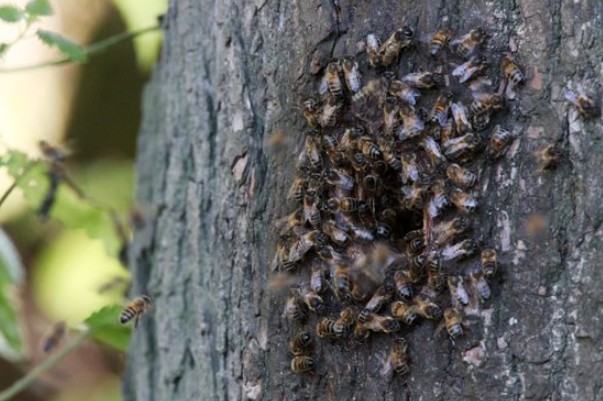
Morphology describes a bee’s structure and external traits, including colour, hair, body proportions and wing venation. Morphometrics is the systematic measurement and comparison of these traits.
Wing studies can compare the cubital index (a ratio between two vein segments) and wing shape with reference populations. Geometric morphometrics compares the positions of identifiable points in wing venation.
Dark colour or a matching wing shape is not enough to establish pure AMM or Dutch origins. Reliable comparison requires multiple bees per colony, suitable references and a documented measurement method.
A practical tool for wing measurement is the online measuring instrument of mellifera.lu, a Luxembourg breeder of the dark bee; the tip comes from the international SICAMM network. You upload a photo of a wing or take one directly with your phone, and the instrument measures the cubital index, the hantel index and the discoidal shift, among other things — the very characteristics that wing morphometry compares with reference populations. The instrument works in German, French and English. Go to the mellifera.lu measuring tool
DNA: the genome and the maternal lineage
Nuclear and mitochondrial DNA answer different questions. They complement each other but are not interchangeable.
Nuclear DNA and the whole genome
In workers and queens, nuclear DNA comes from both mother and father. Studying many DNA variants (SNPs), or sequencing the whole genome, can give a broad picture of relatedness and mixing with other subspecies: introgression.
The outcome depends on sampling, reference populations and the analysis method. Even a genome analysis is not absolute proof of historical Dutch ancestry.
Mitochondrial DNA (mtDNA)
Mitochondria are small cell structures with their own DNA. In honey bees, this DNA is inherited from the mother. An mtDNA haplotype, an identifiable DNA variant, therefore mainly tells us about the maternal lineage.
A maternal lineage consistent with AMM does not rule out mixing in nuclear DNA. Using mtDNA alone to call a colony ‘100% pure’ is therefore insufficient.
From Ireland to Breda: research into the native honey bee
Genetic relatedness as a starting point for nature restoration
Ireland is an important European refuge for the native dark honey bee (Apis mellifera mellifera, AMM). Research by Prof. Grace P. McCormack and her colleagues at the University of Galway has shown that a substantial, genetically recognisable population of this subspecies still occurs there. In 2018, Hassett and colleagues examined 412 bees from 24 Irish counties. Thirty-four mitochondrial haplotypes were found. Several common Irish haplotypes proved identical to previously described Dutch haplotypes.
This correspondence is particularly relevant for nature restoration in the Netherlands. Historical sources and genetic research indicate that after the great bee mortality known as the Isle of Wight disease, Dutch honey bees were brought to Ireland. The presence of Dutch haplotypes in Ireland may thus provide a starting point for further research into the historical distribution and relatedness of European AMM populations.
The follow-up research at the University of Galway is also promising. Research on free-living Irish honey bee colonies showed that this population consists predominantly of bees identified as AMM by their genetics. In 2026, research using whole-genome sequencing additionally confirmed that the genetically pure Irish population is distinct from other European AMM populations studied. At the same time, the researchers warn of increasing genetic admixture caused by the import of other subspecies and hybrids.
Stichting Het Conservatoire wants to put this knowledge to use for the Bijenlandschap De Oude Nassaubossen of Breda. In cooperation with beekeepers and scientific institutions, we wish to investigate which mitochondrial haplotypes are present among Dutch beekeepers who have long worked with the native honey bee, and to what extent these match historically described Dutch and Irish variants.
To that end, we want to explore the possibilities of mitochondrial DNA research on bee samples, among others in cooperation with the Naturalis Biodiversity Center in Leiden. The results can help to better document the genetic history of Dutch AMM lines and to guide follow-up research with nuclear DNA markers.
Our commitment is not only to preserving genetic heritage, but also to restoring a coherent landscape in which native honey bees can once again establish themselves, swarm and take their place as free-living colonies.
From genetic clue to scientifically grounded nature restoration.
Scientific sources
These publications provide an initial reading list. They are external studies, not research findings of Stichting Het Conservatoire.
Wageningen University & Research (2025)
Hoe blijft de Nederlandse zwarte honingbij behouden?Current Dutch research, including on the Texel population.
Henriques et al. (2018) · Scientific Reports
High sample throughput genotyping for estimating C-lineage introgression in the dark honeybeeEuropean DNA research into admixture with the C lineage, including in a Dutch conservation population.
Themudo et al. (2020) · Scientific Reports
Declining genetic diversity of European honeybees along the twentieth centuryResearch on historical museum specimens about the decline in genetic diversity of European honey bees.
Meixner et al. (2013) · Journal of Apicultural Research
Standard methods for characterising subspecies and ecotypes of Apis melliferaStandard methods for studying and comparing subspecies.
Pinto et al. (2014) · Journal of Apicultural Research
Genetic integrity of the Dark European honey bee (Apis mellifera mellifera) from protected populations: a genome-wide assessment using SNPs and mtDNA sequence dataWhy nuclear and mitochondrial DNA need to be considered together.
Buswell et al. (2025) · Journal of Apicultural Research
Whole genome analyses of introgression in British and Irish Apis mellifera melliferaGenome research on British and Irish AMM; published online in 2024.
Ruttner (1988) · Springer
Biogeography and Taxonomy of HoneybeesStandard work on the classification and distribution of honey bee subspecies, based on morphometrics.
Garnery, Cornuet & Solignac (1992) · Molecular Ecology
Evolutionary history of the honey bee Apis mellifera inferred from mitochondrial DNA analysisMitochondrial DNA distinguishes evolutionary lineages of the honey bee, including the M lineage of the dark bee.
Hassett, Browne, Grace P. McCormack e.a. (2018) · Journal of Apicultural Research
A significant pure population of the dark European honey bee (Apis mellifera mellifera) remains in IrelandStudy of Irish AMM with nuclear and mitochondrial markers in 412 bees from 24 counties.
Smith, Valentine, Binetti, Browne, Grace P. McCormack e.a. (2026) · Scientific Reports
Whole-genome sequencing data confirms the uniqueness of Ireland’s native honey beeFollow-up research with whole-genome sequencing, including 75 free-living Irish colonies: the genetically pure Irish population stands apart from other European AMM populations.
Beowulf A. Cooper (1986) · BIBBA
The Honeybees of the British IslesClassic book on the native dark bee of Britain and Ireland and recognising its characteristics.
Thomas D. Seeley (2019) · Princeton University Press
The Lives of Bees: The Untold Story of the Honey Bee in the WildHow honey bees live in the wild, and what that means for natural beekeeping.
Share expertise or historical information?
Do you have relevant literature, archival material or expertise in bee morphology or genetics? We would love to hear from you.