Free-living honeybees
Wild colonies as a key to the Bee Landscape of the Old Nassau Forests of Breda
Ecology · Behaviour · Landscape
A forgotten part of nature
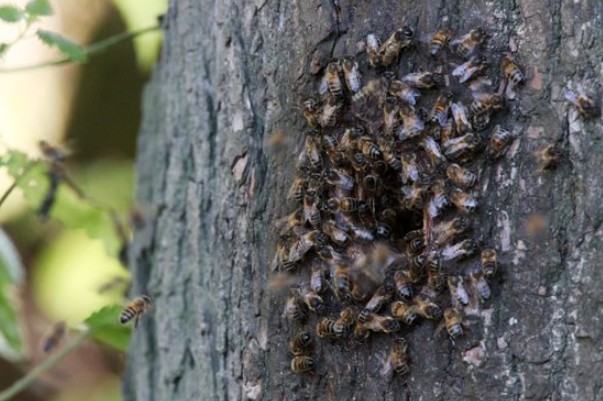
It has long been assumed that the honeybee in Europe survives only as a managed animal, dependent on the beekeeper. Scientific research of recent decades shows a different picture: wherever suitable nest cavities exist, honeybees can sustain themselves. They swarm, find their own home and live without human care. These free-living colonies are a natural part of the forest, just like the woodpeckers that make their cavities.
Thomas Seeley: a lifetime of research in the wild
Prof. Thomas D. Seeley (Cornell University) devoted his entire working life to the behaviour and ecology of honeybees and became world-famous for it. In the Arnot Forest in New York State he showed that wild colonies live there and survive without treatment against the varroa mite. They are spread through the forest, in fairly small tree cavities high above the ground, and multiply by swarming regularly.
In The Lives of Bees (2019) Seeley shows how strongly the way of life of wild colonies differs from that in beekeeping: smaller homes, greater distances between colonies, natural swarming and natural selection. From this he derives principles for beekeeping closer to the nature of the bee — an idea that matches the natural beekeeping the foundation promotes.
Wild honeybees in European forests
Free-living honeybees still exist in Europe too. Requier and colleagues (2019) examined tree cavities in, among others, German and Polish forests and estimated from this that European forests offer room for tens of thousands of wild colonies. Old trees and cavities excavated by the black woodpecker prove to be of great importance. The researchers argue for including wild honeybees in forest management and nature conservation policy.
In a second 2019 publication, with among others the French geneticist Lionel Garnery, Requier and colleagues stress that protecting native subspecies is crucial. Locally adapted honeybees, such as the dark honeybee (AMM), risk losing their traits through import and hybridisation. Free-living populations can form a reservoir of that local adaptation.
How many wild colonies are there?
Visick and Ratnieks (2023) brought together studies worldwide on the density of wild honeybee colonies. Density turns out to vary greatly by region and landscape. Such comparative figures are valuable: they provide a yardstick for investigating, in the Netherlands too, how many free-living colonies a forest or landscape can support.
Significance for the Old Nassau Forests of Breda
The Bee Landscape of the Old Nassau Forests of Breda offers an opportunity to put these scientific insights into practice. Old forests with hollow trees, tranquillity and a varied supply of flowers are exactly the conditions in which free-living honeybees can sustain themselves. Together with ecological corridors, a landscape can arise in which the dark honeybee can once again swarm and settle independently.
The foundation therefore wishes, together with site managers, beekeepers and scientific institutions, to investigate where suitable nesting sites exist or can be restored, and whether free-living colonies are present in and around the Nassau forests. These are intentions: the foundation has not yet carried out this research and presents no results of its own here.
Scientific sources
Thomas D. Seeley (2019) · Princeton University Press
The Lives of Bees: The Untold Story of the Honey Bee in the WildLong-term research on wild honeybee colonies and what it means for natural beekeeping.
Requier et al. (2019) · Conservation Letters
Contribution of European forests to safeguard wild honeybee populationsEstimate of the number of wild honeybee colonies in European forests and the importance of tree cavities.
Requier, Garnery et al. (2019) · Trends in Ecology & Evolution
The Conservation of Native Honey Bees Is CrucialWhy protecting native, locally adapted honeybees is crucial.
Visick & Ratnieks (2023) · Ecology and Evolution
Density of wild honey bee (Apis mellifera) colonies worldwideWorldwide overview of the density of wild honeybee colonies.